The stats panel esports fans didn't know they needed
Riot killed its stats product after poor adoption. The appetite for stats never died — the product did. This is how research reshaped a failed feature into a second commentator for League of Legends and Valorant broadcasts.
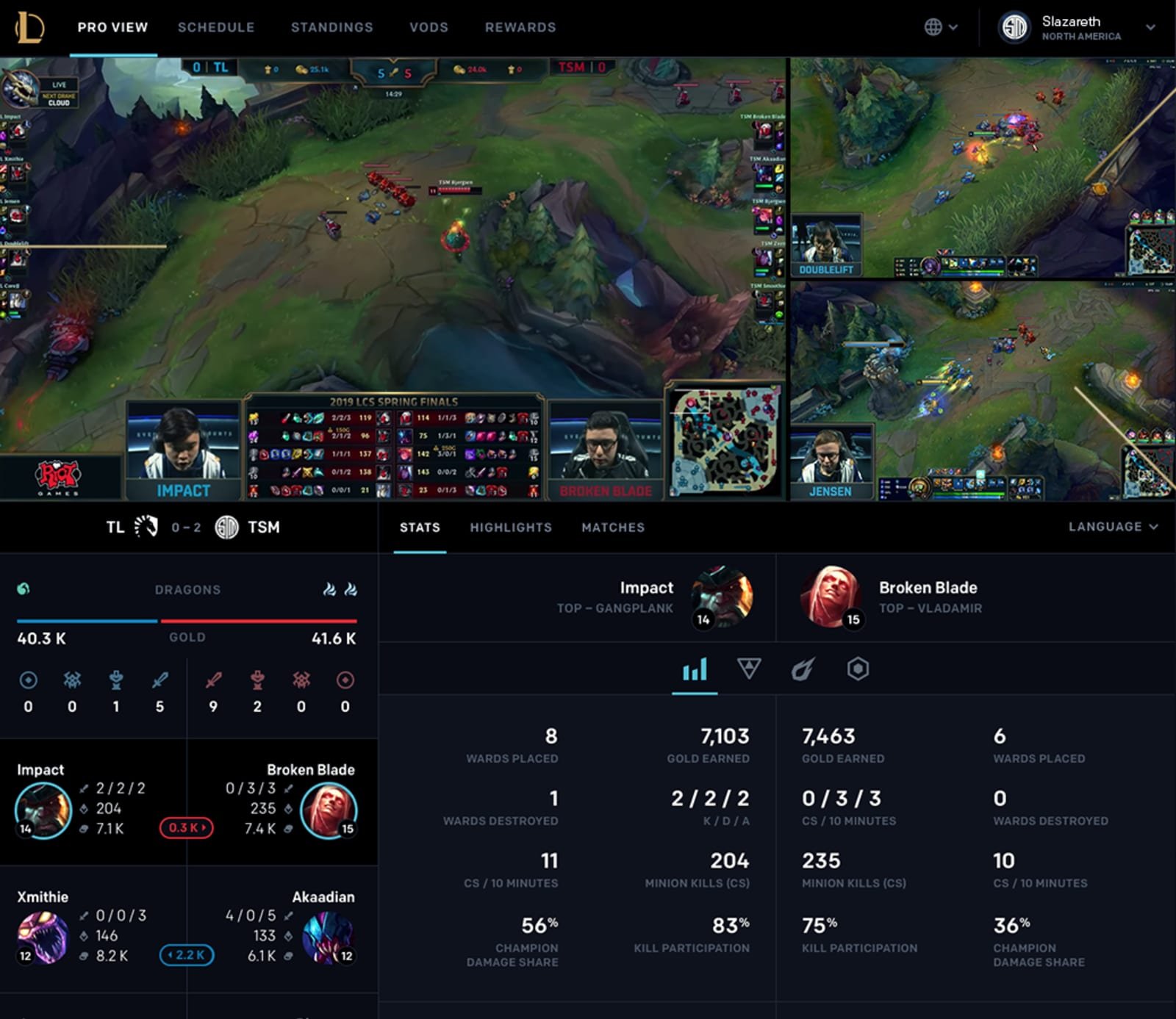
A product was just buried. We had to design its successor.
February 2022: Riot announces Pro View — its paid esports stats service — is being discontinued. Poor adoption. Fans wouldn't pay to dig through screens of numbers while the action was happening without them.
But here's the tension that made this project interesting: esports fans love stats. They argue about them on Reddit, memorise them, build identities around them. The failure of Pro View wasn't proof that fans don't want stats — it was proof that nobody had worked out when, where and how fans actually consume them.
The brief: design a new stats panel for Riot's REN watch experience — across both League of Legends and Valorant — that earns its place on the screen instead of competing with the match for attention.
What we set out to answer
- Which stats genuinely matter to fans watching professional esports — not which stats exist.
- How a stats panel should live alongside the broadcast without stealing focus from the game.
The brief was deliberately ambiguous, so we worked side-by-side with Riot's REN team to shape the scope rather than waiting for it — turning the ambiguity into a strategic advantage: we got to define what "success" looked like before designing for it.
Watching fans watch the game
PC gamers who also watch pro esports are a notoriously hard group to recruit. We found seven dedicated League of Legends fans — and squeezed every drop of insight out of them with a five-step protocol.
General inquiryGaming and esports habits — who they watch, where, and why.
Contextual inquiryWe showed early, mid and late-game clips and asked: what do you need to understand this moment?
Card sortingFans ranked basic and advanced stats from most to least important — separately for early and late game.
A/B concept testsRaw numbers vs bold visual graphs over time — which do fans actually read?
Hypothesis surveyKey hypotheses ranked 1–5, disagree to agree, to pressure-test what we thought we heard.
Honest data onlyWe omitted no-shows and participants who misrepresented their experience — a smaller but truthful sample.
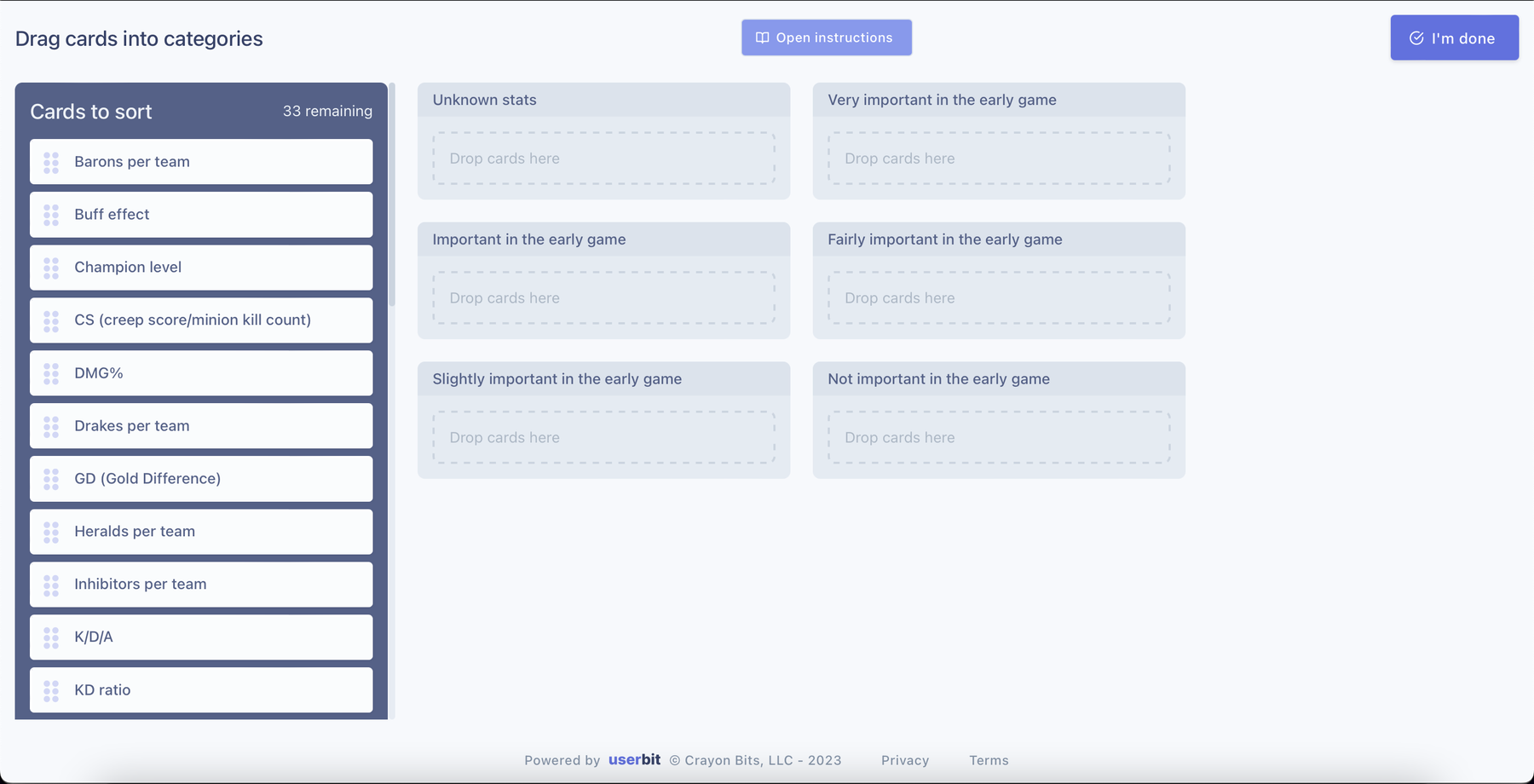
Everything was synthesised into a research presentation that travelled up the organisation — the findings below became the spine of every design decision that followed.
Stats aren't data. They're commentary.
Seven findings emerged — but they all orbit a single idea: a stat is only valuable in the moment it explains.
- The importance of a stat changes over time — what matters at minute 2 is noise at minute 30.
- Stats must serve both education and entertainment — new fans and veterans watch the same broadcast.
- Stats need to tell a narrative that enhances the viewing experience, not interrupt it.
- Too many irrelevant stats create information overload — fans switch off entirely.
- When to show a stat is as important as which stat to show.
- Bold visualisations beat raw numbers — fans consume graphs at a glance, numbers take effort.
- Fans were too engrossed in the action to ever dig through a stats screen three levels deep.
"Stats should be like a nerdy commentator on the broadcast team."
— The insight that reframed the entire projectThat one line became our design north star. A good commentator doesn't talk over the play — they wait for the lull, then tell you the thing that makes the last fight make sense. Our stats panel had to behave the same way.
Don't make fans dig. Surface the story.
If fans won't leave the action to find stats, the stats have to come to them — at exactly the right moment.
The lightbulb moment: every match has natural lulls — buy phases, resets, the breath between fights — where the broadcast and the fan briefly relax. Those lulls are the commentator's window, and they became ours. We flattened the three-level stats screen into two always-visible surfaces:
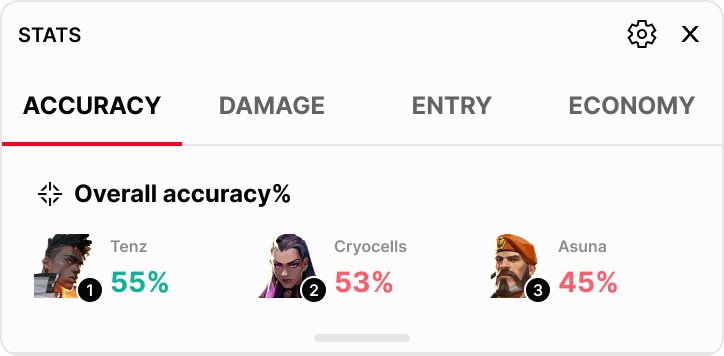
The Stats ModuleFour stat categories that stay relevant at every stage of a match — no digging, no navigation.
The Match FeedEvent-triggered stat cards that explain the action that just happened, delivered during the lull that follows it.
The four always-relevant categories (Valorant)
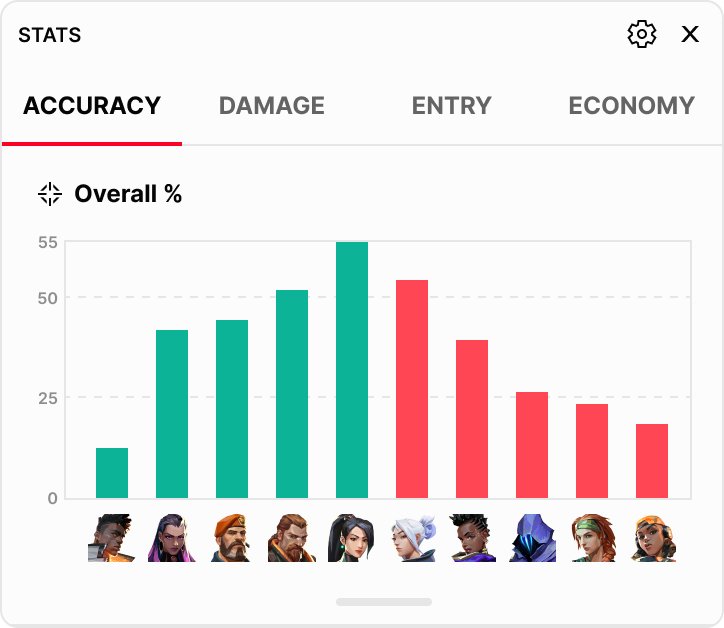
- Accuracy — shot percentage
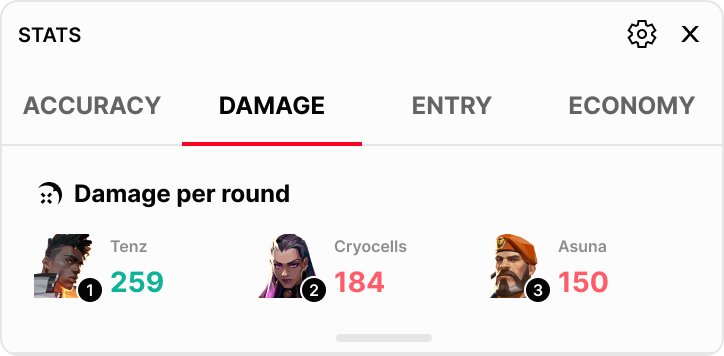
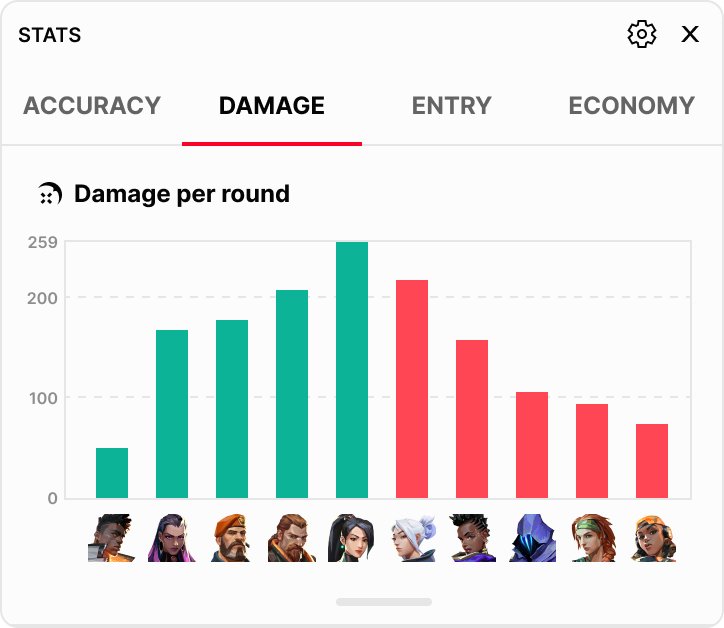
- Damage per round
- Entry success % — who wins the opening duel
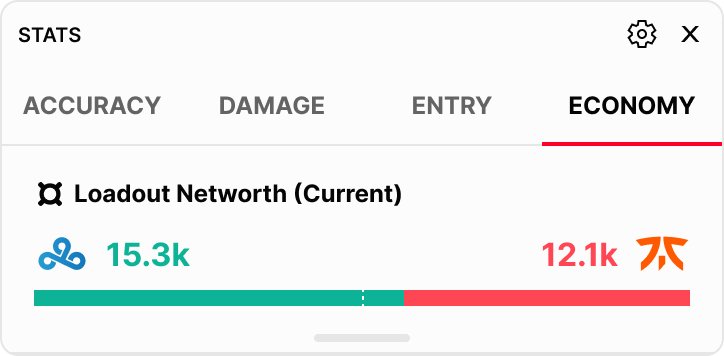
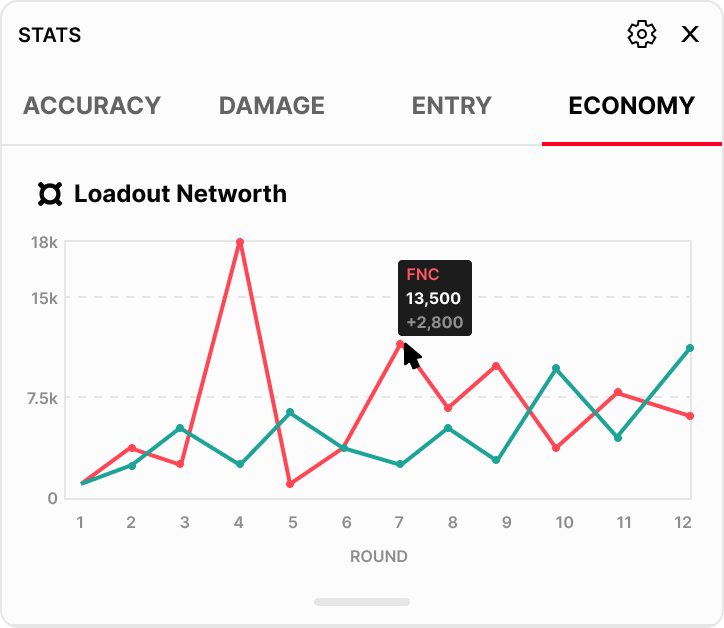
- Team economy — who holds the financial advantage right now
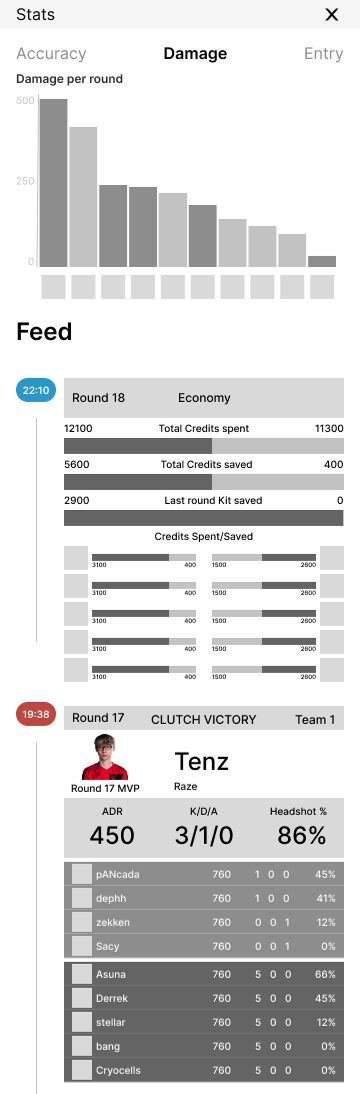
One structural idea — module + feed — resolved all seven research insights at once: right stat, right moment, zero digging.
Sketching the second commentator
Low-fidelity wireframes pressure-tested the concept: could a fan absorb the story of the round in a single glance?
- Stat rankings for accuracy, average damage and entry success at a glance.
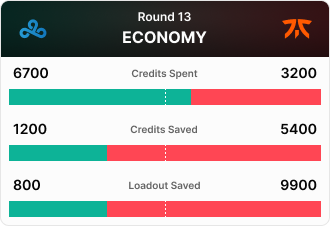
- Economic advantage each round — who spent the most, who's saving.
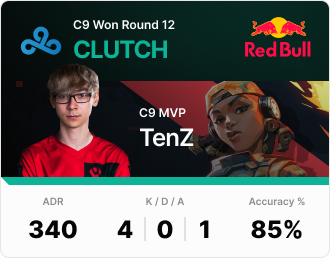
- Clutch moments — who won the last round, with their accuracy and damage.
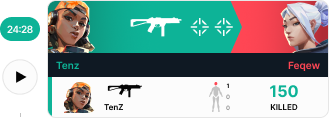
- Kill attribution — who killed whom, because multi-kills get chaotic fast.
Three rules kept the chaos in check: the stats module and match feed are visually distinct areas; team colours follow the defend/attack sides (green vs red) and swap at the half; and feed modules appear in a strict, predictable order so the panel never surprises the fan.
Valorant Stats panel layout
- Toggleable in the REN watch experience on desktop — accompanying any LoL or Valorant broadcast.
- Stats module — collapses and expands, always present, untouched by the feed's scroll. Metrics update live as the game progresses.
- Match Feed — a scrollable stack of time-based modules, newest at the top, pushing older ones down.
- Some modules link out to highlighted plays; others are view-only.
Stats module
Stats module
Halftime colour switch
- Red = attacking, green = defending — colour tells you the side at a glance.
- Team 1 anchors left, Team 2 right — positions never move for the whole series.
- At halftime (after round 12) the sides switch — so the colours swap with them.
- The stats module and every feed module anchor to the same colours; agent portraits face inward toward each other.
Module order
- Newest modules surface at the top; older ones push down into the scroll.
- Each round opens with a Round banner, then the Round Economy module.
- Every kill triggers a kill/breakdown as the round plays out.
- Round over: win banner first, then Round MVP.
- At halftime, a 'Switching sides' banner follows the MVPs.
The panel that earns its pixels
The final stats panel sits on the left of the player in the REN watch experience — toggled on or off by the fan, always scrollable, with the freshest events surfacing at the top.
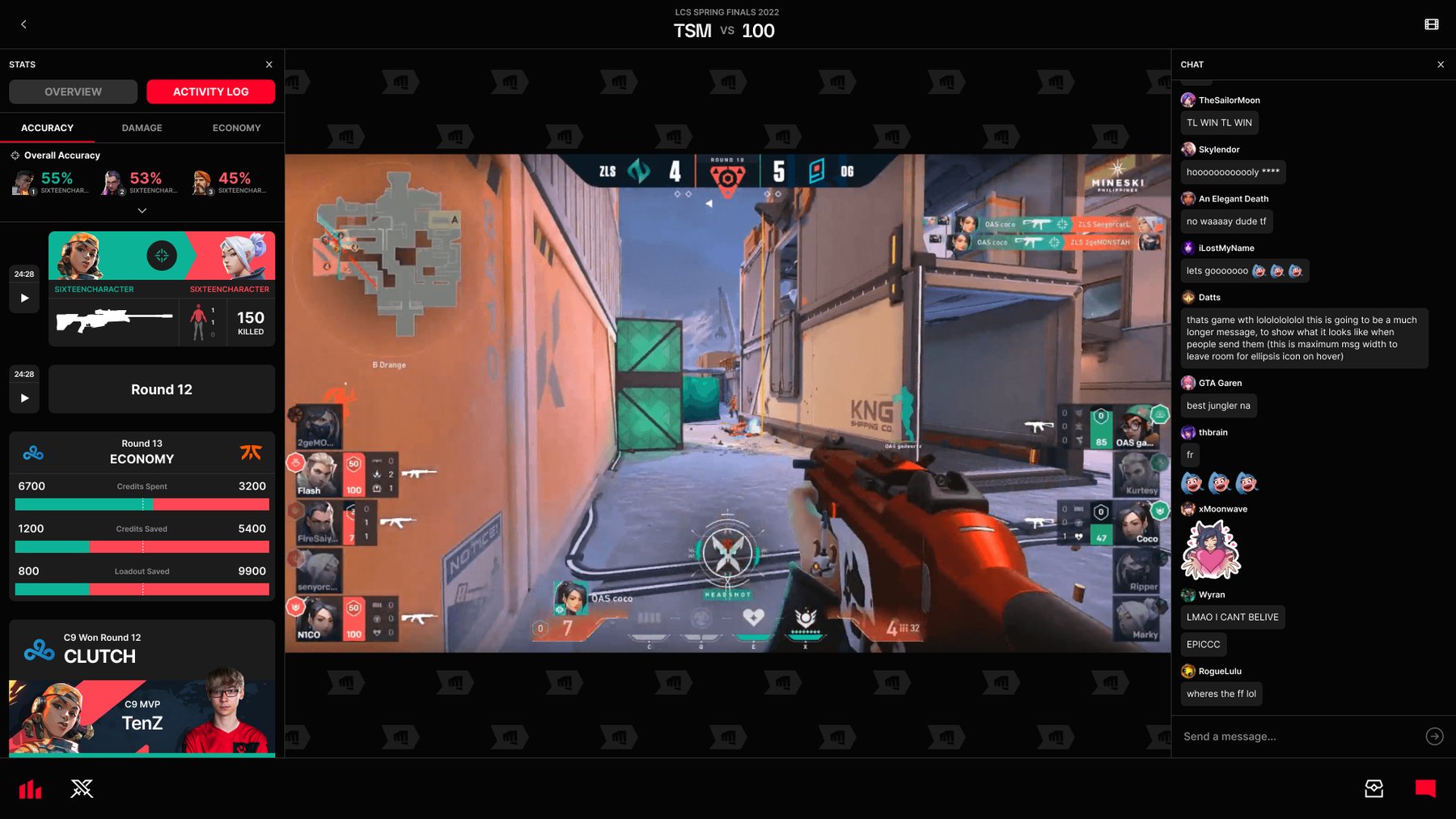
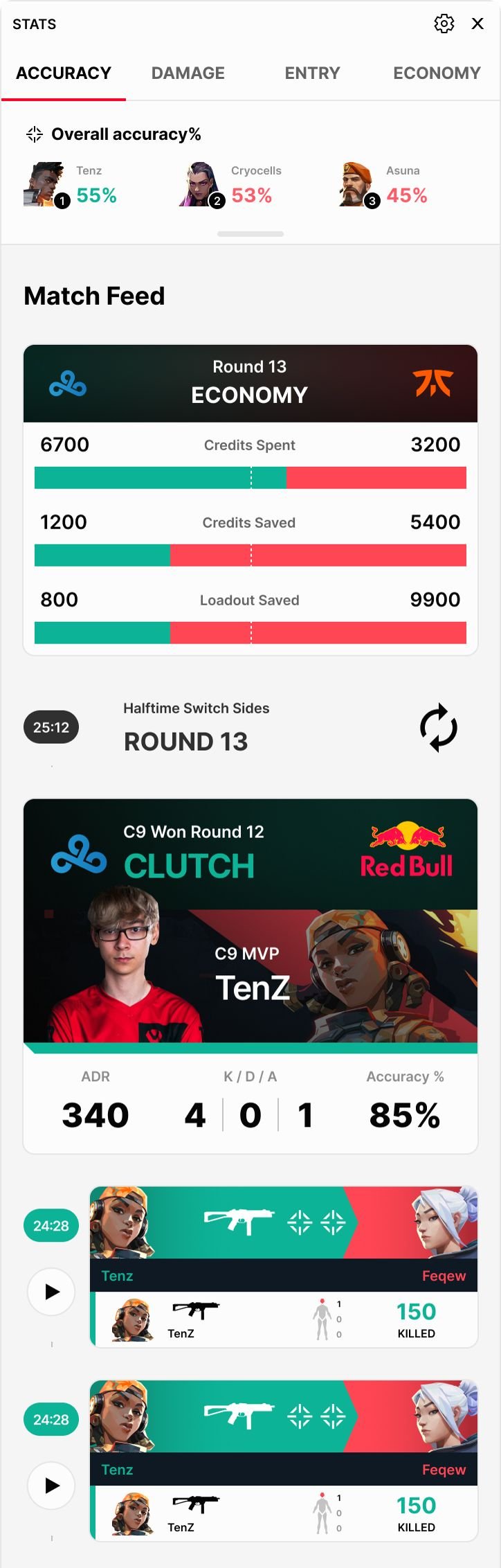
Stats module — collapsed & expanded
Collapsed, the module spotlights the top three performers per category — the headline. Expanded, it becomes team vs team with the best performers in the middle — the full story for fans who want more. Two depths, zero navigation.
The match feed — stats with timing
Feed modules fire on in-game events, exactly like a commentator picking their moment: economy modules open each round, Round MVP lands when a round concludes, and a kill feed module appears with every kill — keeping pace with the chaos without adding to it.
Outcomes & what I'd carry forward
Outcomes- Designs presented up the Riot organisation were met with very positive feedback.
- Owned all Valorant wireframing and the stats module for both LoL and Valorant.
- Acted as the team's key Valorant stakeholder — the resident expert on game mechanics — and supported developers through delivery.
- Research synthesised into a presentation that shaped the feature's scope with the REN team.
What was hard
The ambiguous brief demanded that we shape scope collaboratively instead of executing a spec — uncomfortable, but ultimately where the most valuable strategic work happened. Recruitment was equally tough: some testers no-showed, others misrepresented their experience, and we chose a smaller honest sample over a bigger compromised one.
What I learned
Defining clear research objectives is everything. Go beyond the surface of what you're testing and understand the whole picture — including the client's business goals and who they report to. That's what makes research land twice: with the client, and with the people the client answers to.